tl;dr: Online feeds fragment your continuity of thought and make sustained reasoning harder. Intentional note-taking captures insights so they can connect and evolve over time. When AI can generate plausible content on demand, a personal knowledge management system keeps your judgment grounded in your own tested experience.
The continuity of thought
In an internet saturated with AI-optimised noise, continuity of thought has become fragile. Our feeds are primed for interruption. Short-form content, reels, infinite scroll, and algorithmic summaries collapse context by design. Each item stands alone, and nothing asks you to carry a thought forward, so you are always beginning again.
Thinking doesn’t work well like that. Reflection needs spaces that don’t constantly reset your attention.
The hidden cost for knowledge workers
If your work depends on synthesising information and making judgment calls, fragmented thinking is expensive.
Knowledge work is judged on the quality of output, and quality comes from patterns you have noticed and tested over time. That kind of insight comes from ideas you have pulled at for months or years, not from a single article or search.
A personal knowledge management system as infrastructure
A curated personal knowledge management system resists this fragmentation. Notes link to each other, readings keep their context, and essays can stay unfinished.
A personal knowledge management system is infrastructure: you build it because your future self will need raw material to work with.
Every insight you capture is a deposit into a compound interest account. Any single note may seem trivial. But over time, notes connect. An idea from a book you read three years ago suddenly illuminates a problem you’re facing today. A pattern you observed in one domain transfers to another.
Without the system, you pay twice: duplicate effort, and the loss of the raw notes that experiential learning is built from. Each restart discards the connections that could have pushed your thinking forward, and you never get to build on your own past work.
Zettelkasten and the minimum viable system
The Zettelkasten method builds a knowledge system from atomic notes: each captures one idea in your own words, small enough to stand on its own. Its value comes from the links between notes, which grow into a web you can draw new synthesis from.
A minimum viable PKM begins with this: atomic notes and deliberate connections. Each note stands alone, but also points to rough drafts or longer essays it relates to, or was inspired by. Your drafts, in turn, can link back down to the smaller notes that fed them, so your thinking stays available to build on, whether the next piece is a paragraph or a long argument.
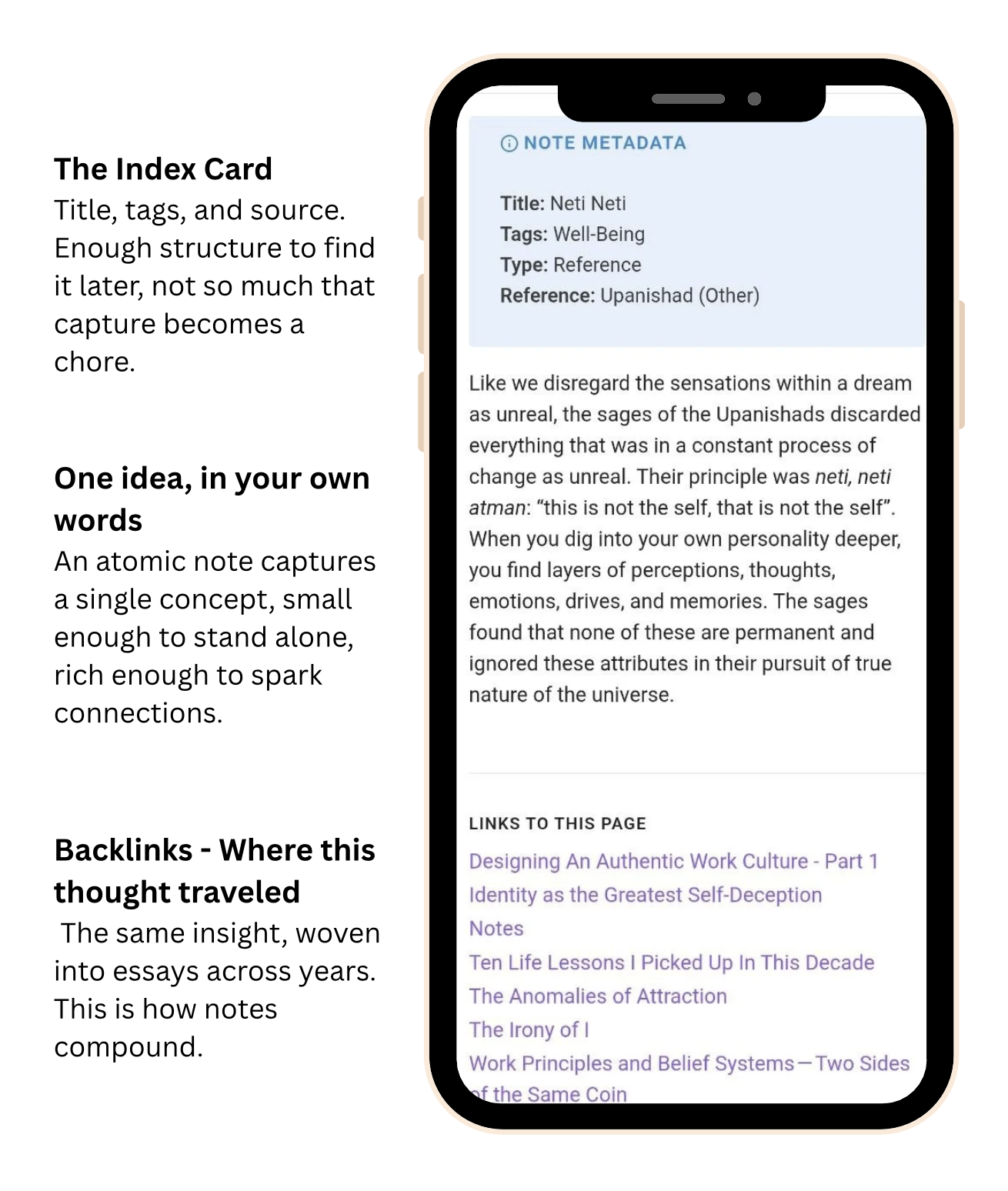
Here’s an example from my vault in Obsidian. A single note on neti neti from the Upanishads was captured once and linked to multiple essays over time. The note stayed the same while each new essay found another use for it.
AI raises the premium on judgment
The rise of AI makes this more urgent, not less. In a world where anyone can generate plausible-sounding text in seconds, the premium shifts to judgment: knowing which ideas matter and why.
AI can summarise a hundred articles, but it can’t tell you which ones changed how you see the world. It can generate frameworks, but it can’t know which one worked when you tried it in your own context. That experiential knowledge exists only in your head, and it stays there only if you have built a place to keep it.
A PKM becomes your competitive edge: a set of tested insights that no algorithm can replicate, because the curation is yours.
The craft of intentional capture
The default internet isn’t optimised for this kind of space. You have to carve it out on purpose, with fewer inputs and tools and habits that reward revisiting over refreshing.
Most people fail at PKM because they treat it as a one-time setup. What works is the ritual: a weekly review and the habit of linking ideas in your own words.
Good knowledge management is a lot like gardening. You plant seeds without knowing which will bloom, prune what isn’t serving you, and show up regularly.
Returns that compound slowly
In an age designed for distraction, protecting continuity of thought is foundational.
For knowledge workers, building a PKM is a matter of professional self-respect: your future thinking deserves more than whatever you can recall in the moment.
The returns are slow. Five years from now, you will either have an archive of your own thinking or be starting from scratch again.